
Hundreds chart, hundred chart, or 100 chart?
These terms usually describe the same learning tool: 10 rows and 10 columns, with 1–10 in the first row, 11–20 in the second, and 91–100 in the final row. “Number chart 1–100” is another common name.
Children can do more than read the numbers. By studying where each number sits, they can explore sequence, ones and tens, place value, and the structure behind addition and subtraction within 100.
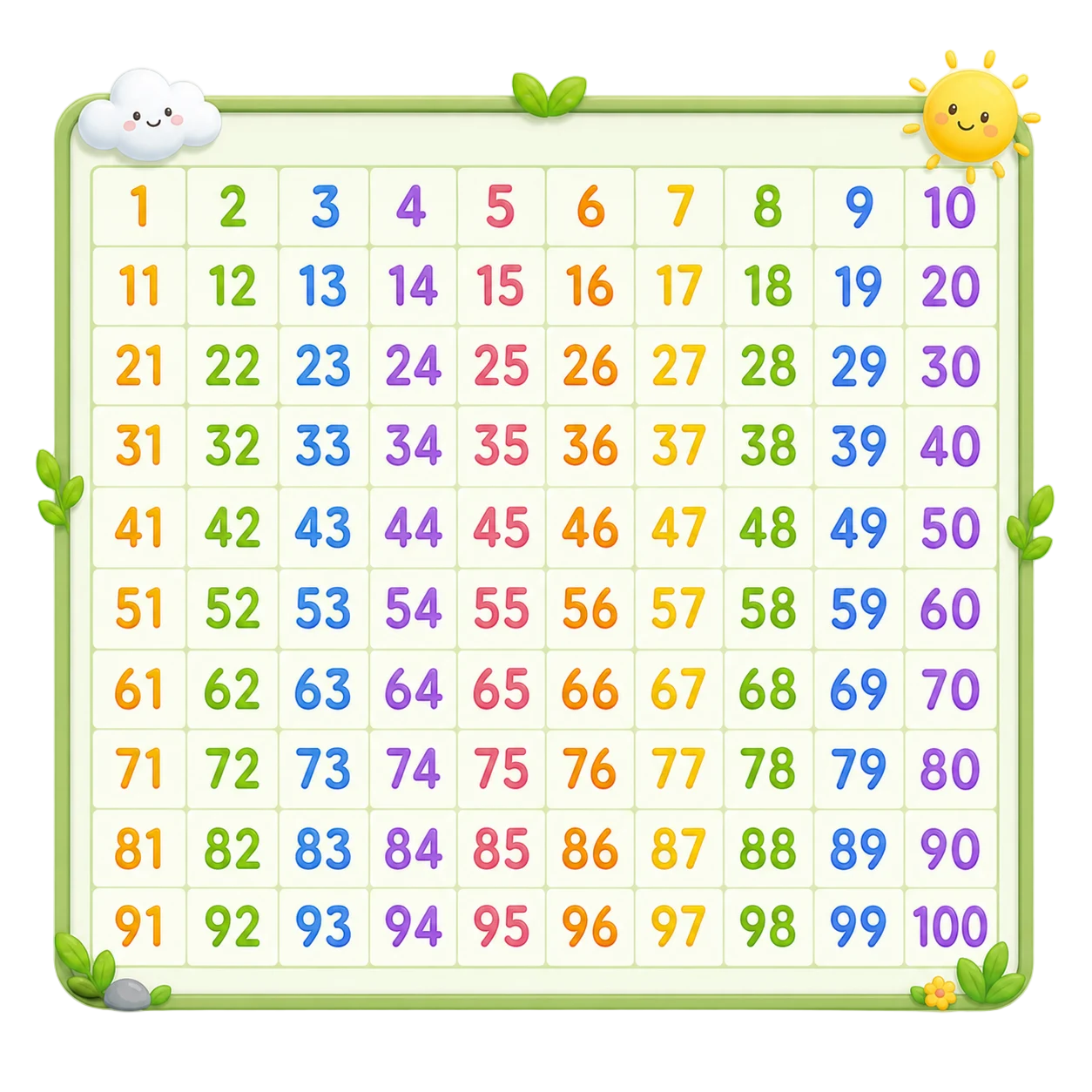
Core patterns on a hundreds chart
Across a row: add 1 to move right
Numbers increase by 1 from left to right and decrease by 1 when moving left. This supports counting, neighboring numbers, and before-and-after activities.
Down a column: add 10
Numbers increase by 10 when moving down a column and decrease by 10 when moving up. The ones digit stays the same while the tens digit changes.
Diagonally: combine both changes
A move down and right usually adds 11; a move down and left usually adds 9. These diagonal patterns are easier after the horizontal and vertical relationships are secure.
What can children learn with a 100 chart?
- Read and order numbers from 1 to 100;
- Find missing, previous, and next numbers;
- Understand 1 more, 1 less, 10 more, and 10 less;
- Explore odd numbers, even numbers, multiples of ten, and skip counting;
- Support addition and subtraction within 100.
From a complete chart to missing-number practice
Begin by pointing to and reading a complete hundreds chart. Next, cover a small number of cells and ask the learner to infer what belongs there. As confidence grows, use larger missing sections or reveal only one anchor number.